I'd been eyeing this particular model since early 2015 after noticing how my 700D was more limiting than expected (and much more than the tons of reviews mostly testing it in JPEG mode addressed), yet it took me ten years to get around and purchase a barely-used model for just €214 and just a little more than 6000 shots – surprisingly around 2500 shots more than MBP claimed – on its equivalent of a speedo. The language also was set to English and the package was undoubtedly French, which wasn't an issue but rather odd.
The body itself really is in excellent condition, with nothing more than two accidental fingerprints on its LCD display. I grabbed by EF 70-200mm f/4 USM and took the 60D on a spontaneous field trip on 19 June. I went with my usual settings: RAW, manual mode, manual focus, f/7.1 to f/9, 1/640s to 1/1250s, white balance set to "daylight", evaluative and spot metering, neutral picture style. I switched between Auto Lighting Optimizer's "off" and "standard" setting during the field trip.
I quickly got used to adjusting all settings via buttons and dials, and the small display in top of the body proved to be much handier than changing settings via my 700D's touch screen. Since the gap between both models in terms of features is relatively small, the 60D offers smaller ISO steps than my 700D. Despite offering a smaller ISO range overall, I could go up to ISO 3200 without experiencing the same amount of noise as my 700D at ISO 800 and I personally became a big fan of ISO 320 and ISO 640 which allow me to set a smaller aperture without the brightness taking a hit.
Sadly, nearly all shots turned out to be overexposed, oversaturated and mostly out of focus, despite using the same settings I roll with on my 700D. White balance, despite being set to neutral, struggled the most when I captured a female B. dia laying eggs on a single plant surrounded by hay; the hay wasn't a very light yellow bordering on white but light red. Lightroom's automatic adjustments were pretty aggressive when loading this shot in particular and I wasn't successful at fixing most of the issues without resorting to Photoshop to at least fix the colors (but not the messed-up focus).
Checking the settings I realized that this 60D was still running on firmware version 1.0.8 which caused some issues in terms of overexposure an oversaturation when using certain lenses. Although none of my lenses were listed and my EF-S 55-250mm f/4-5.6 IS STM later caused unusually strong chromatic aberration when photographing red objects, I installed the latest firmware and all issues were solved. In a similar vein, I also finally upgraded my 700D from 1.1.3 to 1.1.5, though I haven't seen any improvements despite sharing the same chromatic aberration bug which, according to Canon, only was affecting certain lenses AND JPEG shots (so far I discovered more unreported bugs than your average website excessively detailing every detail of cameras – maybe I'm simply unlucky and always end up with those rare faulty bodies from a given series).
While I've gotten used to its features and the location of the power switch, the "bulb" shutter speed being a separate feature instead of being directly integrated into the shutter speed settings is odd.
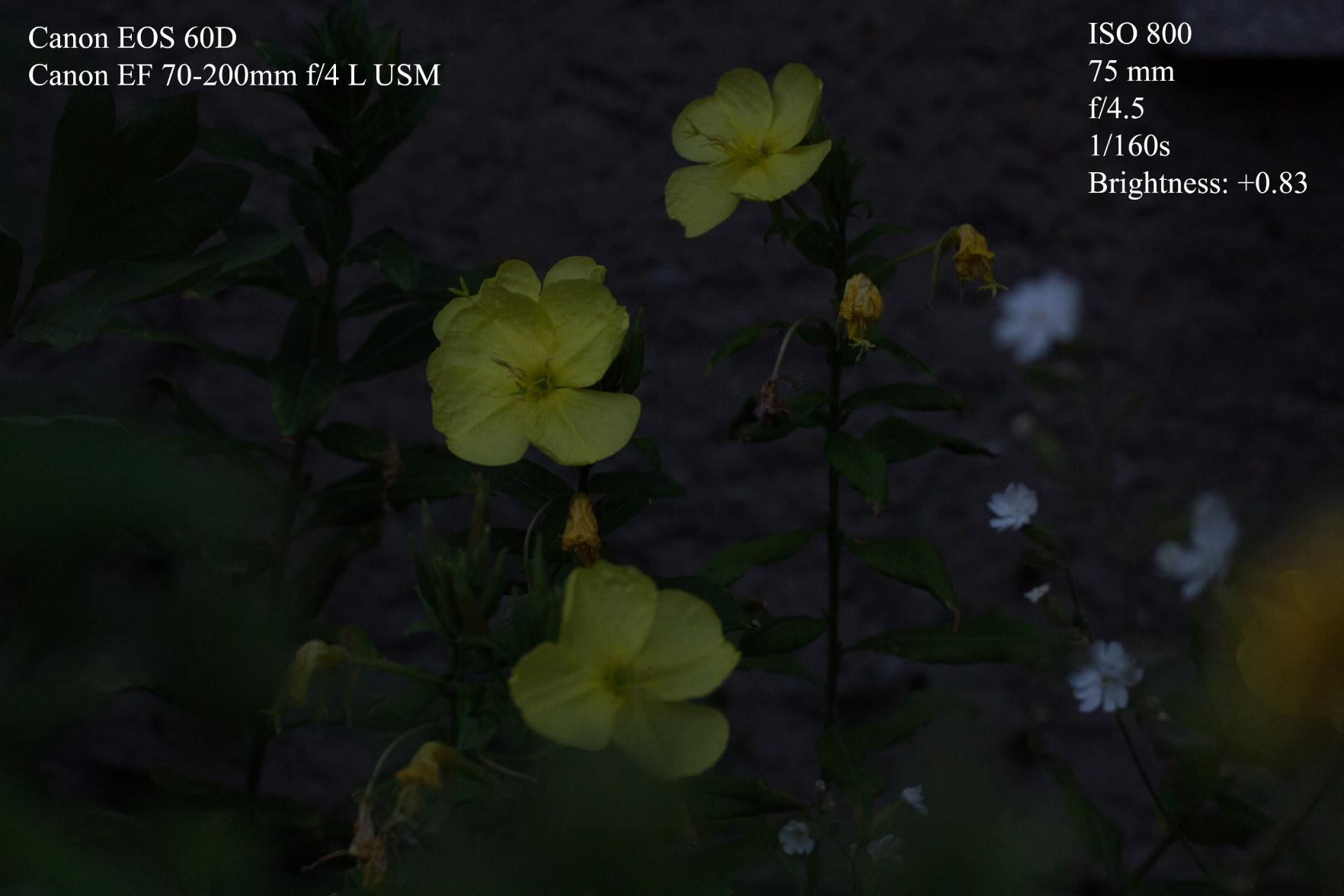
In the evening of 30 June decided to test both my old and my new camera on my blooming evening-primrose, taking into account that my 700D tends to slightly struggle with warm colors such as yellow and orange. Given that both carry an identical sensor, I didn't expect any drastic differences in terms of color dynamics but I was slightly shocked when the 700D produced a better lit photo with my EF 70-200mm f/4 L USM than the 60D, which used to be quite popular among astro photographers prior to the release of the 60Da. Even more shocking was the amount of sensor noise ended up producing in contrast to the entry-level 700D that was released just three years after the 60D and offers slightly weaker specs overall.
All shots share nearly identical settings, minus the slightly varying focal length (and the metering setting; I forgot to set my 700D to "spot"). White balance was kept stable at 5200K.
The same thing was observed when I used my EF-S 55-250mm f/4-5.6 IS. The EF-S lens even performed slightly better on both cameras compared to the "luxury" zoom for full-frame cameras.
It should be noted that the 60D, despite the sensor noise and reduced exposure, produces less grain on average, keeping a little more sharpness than my 700D. In terms of dynamics, my 700D continues to give yellow objects a slight green hue, whereas the 60D is less prone to it.
Only after this test I realized that BOTH cameras actually were missing crucial lens correction data. The 60D lacked data for my 50mm prime lens and my 18-55mm kit lens – considering that those lenses are younger than this body, the missing data was kind of expected. What did leave my head scratching was my 700D lacking lens data for the EF-S zoom lens. I registered all missing data via EOS Utility and chose to make some plans for an additional astro test, as the 60D is said to perform better with ISO values between 1000 and 3200 in contrast to the 700D, which gets horribly noisy starting at ISO 1600. Due to weather forecasts predicting unstable weather conditions for at least a week, this has to be postponed and I continued to track butterflies and odonata with it for the time being.
Since the test involved very little post processing, only increasing the brightness of each shot, my regular field trips with its usual post professing routine proved to be best suited for my new investment. So far most 60D shots were easy to adjust in Lightroom 5.6., with much less grain and a little more details post-post processing.
While I wasn't expecting a huge improvement in terms of image quality, the 60D so far actually disappointed me in respect to its sensitivity to lights in low-light conditions and how it ends up performing better with the cheaper EF-S zoom lens compared to the well-beloved EF 70-200mm f/4 L USM.
On the other hand, the 60D allows more granular settings, offers a second LDC screen that is handier than the 700D's touch screen, and provides some necessary weather sealing – something my 700D lacks and ended up collecting dust and pollen in a few crucial moments. The larger battery also makes quite a huge difference. Post processing no longer makes me worry too much about missed details and leftover grain and sensor noise.
Sadly, most of my frustrations actually stem from the amount of hilariously false data provided by photography sites and communities. dpreview just straight up lists false ISO values for the 60D – in fact, I can set the ISO to Auto, 100, 160, 200, 250, 320, 400, 500 etc. without any kind of "magic" such as Magic Lantern even having been downloaded.
Community posts I found across the web either were published just right after the 60D's initial release, where a bunch of vocal users bemoaned Canon's switch from a magnesium alloy body to polycarbonate resin, glass fiber and aluminum, neglecting the vastly improved ISO range compared to the 50D and the then-innovative articulated LCD screen, or just overtly nostalgic. While it took a hit regarding its burst frame rate, it still is a solid upgrade to the 50D and still a decent semi-pro camera but not a semi-pro warranting this amount of nostalgia exhibited by some (mostly) former users (and their seemingly-universal preference for relying on multiple exposures on actual cameras whilst taking a comparison shot with an iPhone that later would be edited in Photoshop).
This pretty much remind me why I avoid photography communities. More often than not I come across tests where two vastly different lenses are being used and thus end up producing vastly different results without telling anything about the body. Of course, a Canon EF-S 18-200mm f/3.5-5.6 IS with its broader focal length will be much weaker than a Canon EF 100-400mm f/4.5-5.6L IS II USM that won't ever create a wide-angle shot or a generic studio portrait – the lens is important, for sure, but people often end up comparing a lighthouse captured with one lens from a larger distance and during a day to a close-up of a duck with a different lens on a sunny day. It doesn't even demonstrate the differences between each lens properly.
But it's usually those people that sold all of their Canon gear to jump on the Sony Alpha bandwagon. There still are a bunch of annoying Canon fanboys around but the vast majority migrated to Sony to continue... uh, with their weird flexes, including begging for opinions on Reddit even after coming to the conclusion that this camera fits their needs.
Overall, I consider the 60D to be decent for my stuff and I will switch between both my 60D and my 700D depending on the situation. I'm just way to accustomed to both bodies' limitations and quirks to make any more body upgrades in the future and would rather focus on getting my hands on solid but affordable lenses.